

Life audit tool
Re/balance and re/align

What’s important to you?
Feeling off-balance, as though some areas of your life receive all your attention while others get none? Need a way to identify what’s actually important amidst the busy-ness of life or through a transition?
Work-life balance is consistently a theme for people who come to me for coaching; it is also 1 of the top 3 reasons that people seek coaching generally. To cultivate balance, I like to keep an eye on how I’m tracking across important life domains, particularly as a multipotentialite who values excellence. Maybe you relate.
I created this life audit tool as an easy, creative check of where you are now and where you want to be across key life areas. The audit is an adaptation of Paul J Meyer’s Wheel of Life, a widely used coaching tool to support clients to determine and audit their life priorities. Using your insights from your audit, the tool then guides you to take action aligned with what matters most to you.
The process involves 5 simple steps, listed below with an option to visually map your audit.
Please download the worksheet I created for you to follow along.
Step 1: Choose your key areas of life
First, identify 8-10 areas in your life that are crucial for you to feel fulfilled. Name these key areas and be clear on what they mean to you.
There are no right or wrong key areas; what matters is that they are relevant and meaningful to you. I don’t prescribe the key areas because everyone has different priorities. What brings you meaning differs to other people, and what you care about changes over time.
I have used and renamed various categories for my audits over the years. I’ll share a few which you’re welcome to use, adapt or ignore.
Personal finances
Environment (home and work)
Creative practice
Business and work
Personal development and growth
Mental health
Physical health
Spirituality
Friends and family
Romance
Fun, hobbies, restoration
Community
Once you’ve identified your key areas, ask yourself whether the list feels complete. Add or remove any aspects as needed, or rename any categories to ensure they resonate with you. If you’re working with a coach, you might like to work together to identify the areas.
Step 2: Score each of your key areas
Now rate your satisfaction levels for each key area using a 1-10 scale, where 1 is unsatisfied and 10 is fully satisfied. Don’t overthink the score, just trust your instinct.
For any perfectionists or over-achievers: it is pretty much impossible to score 10/10 in all areas of life… nor is that the goal of this activity. Instead, consider the scores as a way to get a birds-eye view of what is going well and where you might like to make some changes to help balance your life a little more.
By the way, the way you score needs to matter to you, so if the idea of a score out of 10 turns you off, decide another way to score your key areas.
Option: Map your scores on the wheel
If you’re visually oriented, you might like to create a spider diagram or pie wheel to visualise your scores. Here’s how you can do this:
Prepare your wheel: Either use the wheel template in the life audit worksheet, or create your own: On a sheet of paper, draw a circle around a round object like a bowl. Divide your circle into 8-10 parts according to the number of key areas you identified. Create a scale of 1-10 for each part, where 0 is in the middle and 10 on the outside line.
Name each key area on the wheel.
Map your score by circling or filling in the relevant number for each key area. You can join the dots with a line, and then you’ll have your spider diagram. Or, use coloured pencils and assign a colour to each life area, colouring in from the inside of the circle to your score like a pie slice. Just create whatever feels like the right fit. Don’t overthink it.
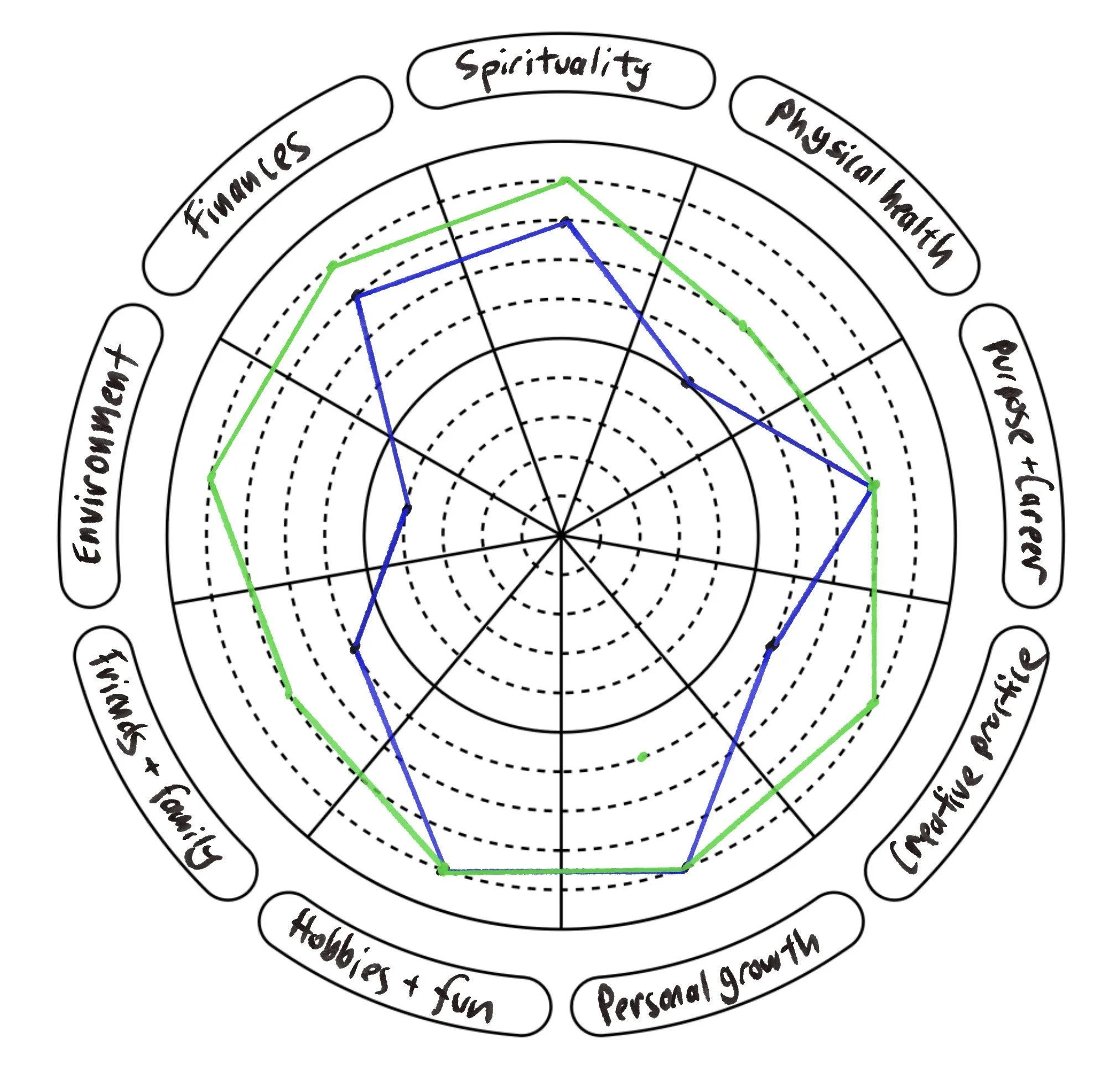
Example wheel with scores for ‘now’ and ‘future’
Optional extra: Score for where you’d like to be
For each key area, reflect on where you'd like to be in future. Identify a score that reflects your personal aspiration for this area. This isn’t an automatic 10/10 score but rather one that reflects your deeper wishes for this area of your life.
If you’re using the wheel, map your future scores onto your wheel. You might choose a different colour to help differentiate it from your existing scores (see wheel image for example).
Step 3: Review your scores

Once completed, sit with your scores and consider the overall balance. If you’ve visually mapped it, observe the shape. Remember, the goal isn’t perfection.
Notice your response to your scores: does anything surprise you? Do you wish to change any of your scores? What would a score of 10 look and feel like? Is there anything you would like to improve in each area?
You might like to journal your reflections. If you’re working with a coach, this can be a powerful topic to work on together.
Step 4: What feels most important?
Life tends to demand more of us in some areas than others, and constantly shifts. To prioritise a few areas isn’t neglectful - or permanent. Rather, it's a way to concentrate your energy where it is most needed in a particular season.
Reflect: Ask yourself:
Which 1-3 areas currently feel the most important? Note your scores for those areas.
What change/s would make the biggest positive impact on your overall life satisfaction?
This reflection allows you to consider your priorities in context of the big picture.
Now, choose one area: Don’t overthink this, just go with the one that feels important right now. (You’re welcome to repeat this for other key areas if you want to, but for now, let’s focus on one).
Consider, what would a 10 look and feel like in this key area? Write a short vision for this key area. For example, a statement for creativity might be, ‘My creative practice has regular alone-time and social connection, so that I am inspired, accessing flow and making weekly output’.
Step 5: Sweetly simple actions
Well done on identifying a key area vision. Now let’s explore what actions could increase your level of satisfaction in that key area.
Brainstorm 3 actions that will lead to an increase of your satisfaction in your key area for the next 90 days. Aim for actions that are sweetly simple: outside of your ‘usual’ routine (i.e. you wouldn’t be doing them anyway) while achievable… even delightfully so.
Sweetly simple actions are trackable, which means they can get you started towards your vision, even if slightly challenging. For example, 15 minutes a day of sketching will get you on the path towards making weekly creative output; or, running every day (however far) is necessary to complete a marathon. Remember, the goal behind your actions is your satisfaction, not perfection.
Before you finish here, identify when in your schedule you can take these actions.

What now?
We all have incredible strength, wisdom, and creativity within us, but sometimes these get buried by the demands of careers, families, and societal expectations. Use the audit whenever you feel the need to reset or rebalance, or need to work out what’s working and what’s not.
You can also adapt the audit for other purposes, such as reviewing your progress on goals, a deep dive into one key area of life, or checking which of your values show up most strongly for you. (Need help to find your values? Use my free workbook to find yours in a unique, creative way).
I currently use the life audit as part of my half-year planning and review. Initially, I used it quarterly for my 90-day goal setting, particularly when I was making intensive work-life pivots. I also like to reflect on how scores for certain areas change over time.
I’d love to know how you get on with this exercise, and how you modified it to suit your own needs. What worked well for you? Email me at karen@DrKMcB.com and let me know!